
Scope 2 is often considered one of the easiest parts of a carbon footprint to decarbonize. In practice, however, it can be difficult to navigate the many available options and identify the most efficient, credible path for your organization.
In this article, we explore the different ways to address your Scope 2 emissions and choose a strategy that fits you best. The first step should always be evaluating energy sobriety measures wherever possible. That said, as we shift toward the electrification of uses, such as adopting electric vehicles or heat pumps to phase out fossil fuels, decarbonizing your overall activities may actually lead to higher electricity needs. This makes the carbon intensity of your electricity mix more critical than ever.
That said, there are three primary ways to decarbonize your electricity mix and tackle your Scope 2 emissions:
Contracting green electricity supply
Purchasing Guarantees of Origin (GOs) through a broker
Signing Power Purchase Agreements (PPAs)
Green electricity contracts
Green electricity contracts are the most common way to get access to renewable electricity. They are provided by electricity suppliers, and take the form of a regular electricity contract, usually backed by guarantees of origin, that ensures the delivery of green electricity directly to your meter.
They are a solid solution for most users, as they provide a simple and easy way to get access to renewable energy. Depending on market trends however, the additional overcost of subscribing such a contract can range from null to appreciable.
Not all green electricity suppliers are the same too. Some only rely on purchasing GOs (see below for more information), while others are also producers which actively support the creation of new renewable capacity. For a more credible decarbonization claim, always prefer these actors, such as Enercoop in France or Ecotricity in the UK.
In some cases however, these options might not be available: you can sometimes not have the possibility to choose your own contract when you are renting offices, or you sometimes are a large consumer which makes your access to retail green electricity contracts either tricky or pricey. In such cases, other options are available.
Guarantees of Origin
Guarantees of Origin (GOs) are a system of certificates that exists under different names in different electricity markets, but functions more or less the same way. They are a certificate emitted for each 1 MWh of renewable electricity produced. They can then be exchanged and purchased as a proof that 1 MWh of green electricity was produced for each 1 MWh supplied. They then need to be retired in order to be counted as zero emissions in Scope 2 accounting.
While most companies are not authorized to possess and trade GOs, they can still access this system through brokers like STX or Redshaw Advisors. You can always purchase and retire GOs matching your total electricity consumption, in order for you to be able to offset your Scope 2 emissions.
While very effective and relatively inexpensive, this system also offers the weakest claim to actual decarbonization. We thus recommend to go for this only in cases where no other options are readily available.
PPAs
Power Purchasing Agreements (PPAs for short) are a special kind of contractual instrument, in which the purchaser contracts with an electricity producer in order to purchase all or part of the annual electricity produced by an installation.
These contracts can take many forms, and are reserved for large electricity consumers for which it makes sense to secure a steady and inexpensive supply. As such, this solution should be considered for companies and facilities where annual consumption of electricity reaches at least 10 GWh. While these contracts can be hard to access (they usually require going through a “sleeve”, meaning someone who will bundle consumers looking to get access to a PPA and then contract with the producer), they are a fantastic way of gaining access to renewable electricity while directly supporting the increase in total capacity.
As prices are negotiated outside of the market, they can also be a way to hedge against price variations in the mid term, and can sometimes even offer savings compared to other more standard contractual instruments.
The future of Scope 2: What’s changing at the GHG Protocol?
This past fall, the GHG Protocol launched a consultation to gather insights on the future of Scope 2 guidelines. These updates will affect both location-based and market-based reporting. Carbometrix participated in this consultation to advocate for a balance between high environmental ambition and operational reality.
1. Location-Based reporting: A new hierarchy of emission factors
The proposed guidelines introduce a new hierarchy of emission factors, prioritizing data that is as local as possible.
The hierarchy: Priority is given to sub-national emission factors (such as state or regional grids) over national ones. Furthermore, companies should use factors that account for electricity imports and exports.
Temporal matching: The Protocol introduces the concept of monthly and hourly consumption data. Where hourly data isn't available, the use of "load profiles", which estimate consumption patterns for specific sectors, is proposed.
Accessibility: These recommendations apply as long as the data is "easily accessible," meaning it should be open-source.
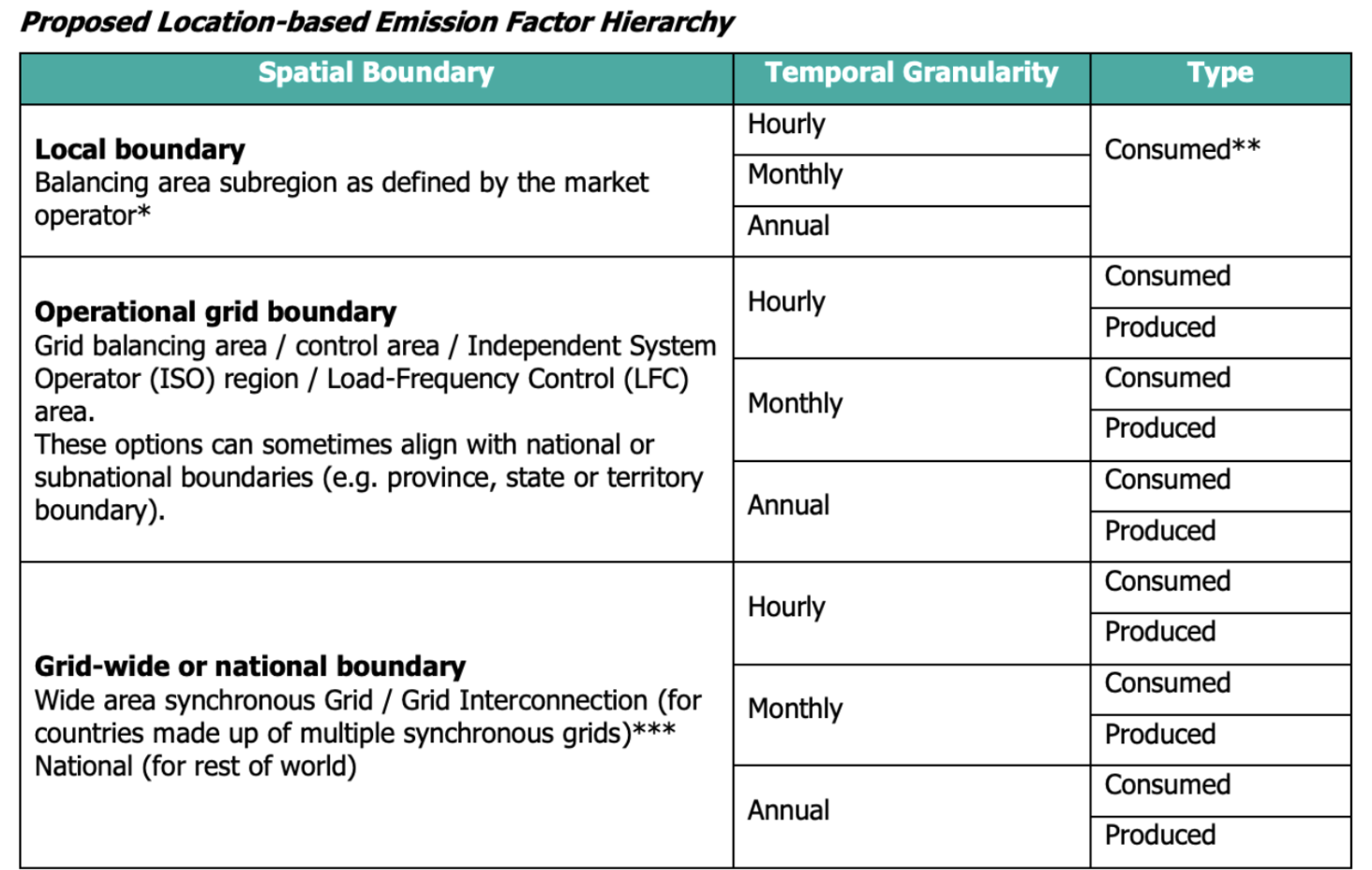
Source: GHG Protocol
Our recommendation: We generally support increasing the granularity of carbon accounting, provided it leads to actionable results. However, based on our experience with SMEs and mid-caps, we recommended that high-resolution data remain a recommendation rather than a requirement, as the data collection remains a major hurdle. Furthermore, for many sectors, shifting working hours to match "cleaner" hours is operationally impossible or provides negligible carbon savings relative to the total footprint.
2. Market-Based Reporting: Moving toward hourly matching
The most significant change for market-based reporting is the requirement for "hourly matching" for certificates.
Real-time correlation: Contractual instruments (like GOs) would need to be issued and redeemed for the same hour as the electricity was consumed. This is a major shift from current methods where annual matching is the norm.
Geographic interconnection: Instruments must come from regions physically interconnected with the company’s operations. For example, a company in Spain could no longer use certificates from Iceland.
Mandatory residual factors: The use of residual emission factors would become mandatory to prevent double-counting of renewable energy.
Our recommendation: We strongly support these updates. Research shows that uncorrelated certificates don’t effectively drive the development of new renewable capacity. Hourly matching, however, encourages investment in resilient grid infrastructure like battery storage (BESS).
To make this transition realistic, we proposed:
A high initial threshold: These rules should first apply to large consumers (e.g., those above 50 GWh/year).
The threshold should be set to capture the companies representing the bulk of regional electricity consumption.
Companies should be given a three-year grace period to transition their existing procurement strategies to the new hourly matching standards.